Author Topic: Questions about the modern use of quartz in lamps  (Read 493 times)
Multisubject
Member
*****
Offline

View Posts
View Gallery


WWW
Questions about the modern use of quartz in lamps « on: January 25, 2026, 10:55:52 AM » Author: Multisubject
When I say "modern" I am talking about two topics: compact metal halide lamps, and LED halogen retrofits. Lets start with compact metal halide lamps:

Modernized compact metal halide lamps (double-ended or bipin base) are shrouded with a small diameter quartz outer envelope. This is necessary because of the high temperature involved having the outer envelope is such close proximity to the discharge tube. Maybe they could've used aluminosilicate, but whatever, not what I am talking about. Since the outer envelope is quartz, they dope it with a UV blocking additive so no UV gets through to damage you. This makes sense.

But why don't they just use the additive in the quartz discharge tube itself (excluding CMH obviously)? The would mean you need less special additive to so the same job. This would also open the opportunity for non-extinguishing exposed-rated normal glass bulb MH lamps that don't need a UV shield tube suspended around the discharge tube.

Next is LED halogen retrofits. These are single or double ended LED retrofit lamps for halogen sockets. Like this one:
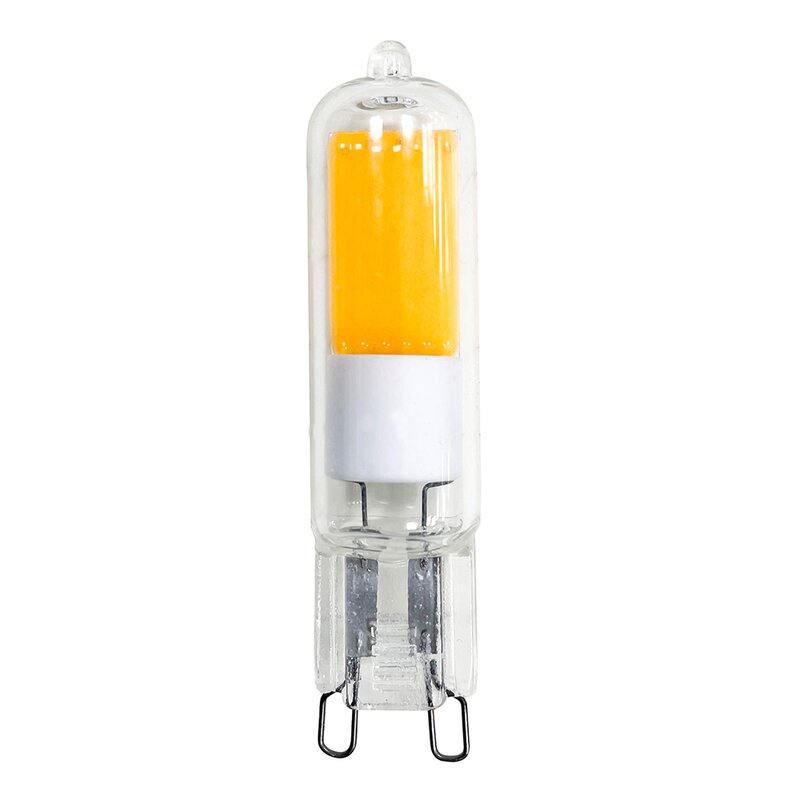
At first glance this may seem very reasonable. But I assure you it is not. See the molybdenum foil seals at the bottom? That means this lamp is made of quartz. I know why they are doing this, because they are still using their old quartz halogen making equipment to make new LEDs. But I feel like it would be so simple to modify this kind of equipment to use soda-lime glass, and it would save them a ton of money. Dumet and soda-lime tubing is almost certainly cheaper than molybdenum foil and fused quartz tubing, not to mention the savings associated with switching from oxy-fuel to air-nat gas.

I don't know why I care, but it is just so ridiculously unnecessary that I gotta say something.

Anybody know a lot about quartz who can answer these questions? Thanks

Logged

"The only stupid question is the one left unasked"
Public Lamp Spec Sheet

Medved
Member
*****
Offline

Gender: Male
View Posts
View Gallery

Re: Questions about the modern use of quartz in lamps « Reply #1 on: January 26, 2026, 01:40:12 AM » Author: Medved
The arctube quartz has to handle way more than just some distributed heat, so using anything that may affect the material is not that good idea. The outer bulb would need to be used anyway and it would have to be quartz as well because of the temperatures, so it is easier to really optimize the arctube material to work best for the arctube and handle the rest in the way less stressed outer.
Logged

No more selfballasted c***

Multisubject
Member
*****
Offline

View Posts
View Gallery


WWW
Re: Questions about the modern use of quartz in lamps « Reply #2 on: January 26, 2026, 09:29:02 AM » Author: Multisubject
Ahh I see, I did not know that the UV blocking dopant affected the quartz like that. Makes sense.
Logged

"The only stupid question is the one left unasked"
Public Lamp Spec Sheet

Medved
Member
*****
Offline

Gender: Male
View Posts
View Gallery

Re: Questions about the modern use of quartz in lamps « Reply #3 on: January 30, 2026, 07:54:22 AM » Author: Medved
I can not say I would "know" that for sure, I'm just pointing out the engineering is about somehow weaseling out between limitations imposed from each direction, most often being impossible to really satisfy all requirements perfectly, so you just have to chose which ones to compromise and how much. And many of the effects involved you just do not know.
So the more requirements you put on any component, the less room you get to fulfill them. So if you may push some requirement out (e.g. the ability to block the UV for the arctube material), the less risk there will be for the dopant to interfere with some other property you really need there (like the strength against the pressure, heat and e.g. corrosion from the arctube fill material at the same time, or at minimum the extra heat loading from converting that UV energy into heat).
Logged

No more selfballasted c***

RRK
Member
*****
Offline

Gender: Male
View Posts
View Gallery
Roman


Re: Questions about the modern use of quartz in lamps « Reply #4 on: January 30, 2026, 03:07:13 PM » Author: RRK
How about the idea of glass bulb from the lamp pictured being not quartz at all?

Molybdenum foil is elastic and will stick (and even better due to lower COE mismatch) to borosilicate or alumostlicate glass. Even there is a molybdenum glass having COE of ~5*10-6

Also, this is a LED lamp, so even 100% airtightness is not mandatory...

Logged
Multisubject
Member
*****
Offline

View Posts
View Gallery


WWW
Re: Questions about the modern use of quartz in lamps « Reply #5 on: January 30, 2026, 03:10:11 PM » Author: Multisubject
@RRK
I never considered that! That is a possibility, though not sure if borosilicate is warranted here. IDK
Logged

"The only stupid question is the one left unasked"
Public Lamp Spec Sheet

RRK
Member
*****
Offline

Gender: Male
View Posts
View Gallery
Roman


Re: Questions about the modern use of quartz in lamps « Reply #6 on: January 30, 2026, 10:44:46 PM » Author: RRK
Next time I see such lamp at some DIY store or market, I'll pick a sample. I believe we can non-destructively test quartz presence by UV light with some certainty.

step 1 - shine some UVA.
If glowing bright blue - likely some UV-block quartz is reused here. So the lamp is most certainly quartz. Regular glass sometimes shines at UVA, but typically not that bright.
If not, check with UVC source.

step 2 - checking with UVC lamp on some UVC-exclusive phosphor like willemite.
If transmits UVC - most likely quartz.
If not - some not quartz glass.

Next, the lamp can be destructively tested by trying to melt the glass. Quartz for sure will start to melt only in the hottest flame of oxygen torch, glowing bright white.


Logged
James
Member
*****
Offline

Gender: Male
View Posts
View Gallery


WWW
Re: Questions about the modern use of quartz in lamps « Reply #7 on: Today at 10:42:16 AM » Author: James
Over the past decades there were many, many attempts to make quartz metal halide arc tubes from UV-stop quartz.  It does not work.

Firstly, the additives cause the softening temperature to be reduced.  Arc tube loading has to be reduced to avoid premature failure, and that causes a decrease of the halide vapour pressures and inferior performance.
Secondly, the cerium-titanium and/or aluminium ions in the UV-stop quartz make it more susceptible to halide corrosion, so again reduced life.

Regarding the LED Filament G9 type lamps, quartz is required to prevent overheating of the silicone LED during sealing.  That might sound counter-intuitive, since quartz has a much higher softening temperature than other glass types.    But speed is of the essence here.  With judicious use of liquid nitrogen coolants, quartz can be raised to its softening temperature, pinch-sealed, and cooled back down faster than normal glasses where prolonged annealing periods are required to remove stresses caused by the glassworking operation.  It is really challenging with soft and hard glasses to cool them fast enough without cracking, and during that time there is greater heat flux from the glass to the LED inside, which can cause degradation of the silicone and thermal expansion related damage to the silver plated gold bonding wires of the LED chips.
Logged
Multisubject
Member
*****
Offline

View Posts
View Gallery


WWW
Re: Questions about the modern use of quartz in lamps « Reply #8 on: Today at 11:01:18 AM » Author: Multisubject
@James
That makes so much sense! Seems like a lot of effort is required to do this, no wonder these aren't super common.
Logged

"The only stupid question is the one left unasked"
Public Lamp Spec Sheet

Print 
© 2005-2026 Lighting-Gallery.net | SMF 2.0.19 | SMF © 2021, Simple Machines | Terms and Policies